

 Some of the links on this site may be affiliate links. ICOBench may receive advertising commissions when users visit recommended platforms via our affiliate links, at no additional cost to you. All recommendations are based on a comprehensive review process.
Bitcoin payments received an uncomfortable reminder this weekend that scaling BTC is not only a speed problem. BTCPay Server released version 2.4.2 on August 7 to patch what it described as a critical vulnerability that was being actively exploited, urging users to update immediately. The same release fixed a two-factor authentication bypass involving Greenfield Basic authentication.
The incident does not mean Bitcoin or the Lightning Network itself was broken – BTCPay Server is a payment infrastructure used by merchants, and the vulnerability sat in software surrounding that. Still, it lands at an awkward moment for a technology built to make Bitcoin more practical as money.
BTC trades at $64,867.11, down 0.03% today but up 3.58% over seven days, while Ethereum has gained 3.69% over the week to $1,908.56. Bitcoin remains vastly more valuable as an asset than as an everyday payment currency.
That is an issue that Bitcoin Hyper (HYPER) wants to fix from another direction. The project is building a Bitcoin Layer 2 with an environment built adjacent to Solana to allow faster BTC transfers and decentralized applications. HYPER costs $0.01368 in a presale that has raised $33 million, with staking currently paying 35% APY.
The extremely successful raise suggests there is considerable appetite for infrastructure that makes Bitcoin useful beyond simply holding it.
How Bitcoin Hyper Builds a Broader Payments Layer Around BTC
Bitcoin Hyper is not trying to make Bitcoin’s base chain behave like Solana. In fact, Bitcoin’s conservative design is one reason it has become such a valuable settlement network. The trade-off, however, is limited throughput and little room for the sort of rapid smart contract activity normal elsewhere.
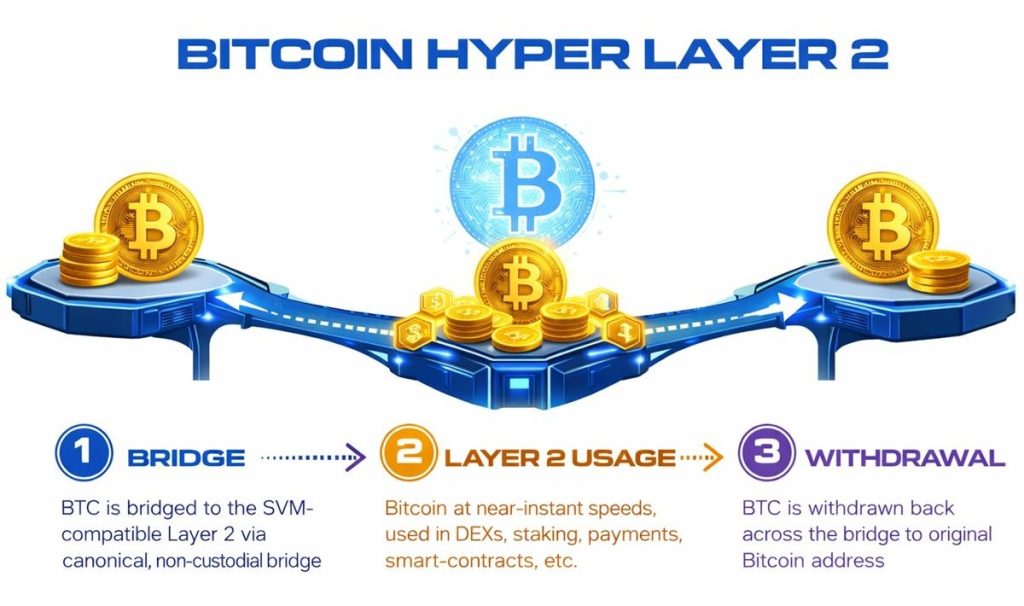
Bitcoin Hyper places that activity on another layer – a network using the Solana Virtual Machine as the backbone, giving developers a high-throughput environment where they can build payment tools, decentralized exchanges, staking products, and other applications around Bitcoin. BTC can then move through this environment with near-instant finality.
Well, well… Looks like art gets better when its a little $HYPER. ⚡️🔥https://t.co/VNG0P4GuDo pic.twitter.com/tHluyiARvP
— Bitcoin Hyper (@BTC_Hyper2) August 10, 2026
For users, the intended improvement is straightforward. Bitcoin no longer has to sit idle until somebody wants to transfer it on Layer 1 (at slow speeds with costly fees). Once available within the Hyper environment, BTC can be sent near-instantly at sub-cent costs, or put to work inside applications that would be cumbersome to run directly on Bitcoin.
Bitcoin Hyper then batches Layer 2 transactions, uses zero-knowledge proofs to establish their validity, and periodically commits the Layer 2 state back to Bitcoin. That lets the faster network handle much of the activity while Bitcoin remains the settlement foundation underneath it.
HYPER itself is intended to pay for transactions, support staking, and eventually give holders governance rights. In practical terms, it becomes the token users need to interact with the network, rather than another asset competing with BTC for the role of money.
That is a broader proposition than a payments channel alone: Bitcoin Hyper is trying to create an application economy around Bitcoin, with payments as one of the easiest places to demonstrate why faster execution matters.
Could HYPER Be the Next Crypto to Explode?
Bitcoin Hyper is pursuing a programmable Layer 2 where payments can sit alongside trading, staking and decentralized applications. The project explicitly seeks support for DeFi operations and decentralized exchanges as part of the network it is building.
That gives HYPER access to a potentially larger opportunity than simply shaving time from a BTC transfer.
Ethereum and Solana became useful because developers could continually invent new reasons to interact with them. Exchanges attracted traders, lending markets attracted borrowers, and games attracted users who cared little about the underlying infrastructure. Bitcoin accumulated greater monetary weight, while comparatively little of that application activity centered on native BTC.
A capable Layer 2 changes the question from “How fast can Bitcoin pay?” to “What else can Bitcoin owners do?”
That is closer to Satoshi Nakamoto’s original framing than treating every BTC as something that should remain untouched forever. Bitcoin began as peer-to-peer electronic cash. Its emergence as a digital property was extraordinary, but it does not have to be the network’s final useful form.
The $33 million already committed to Bitcoin Hyper indicates buyers see value in that possibility. Presale fundraising cannot prove that developers will arrive or that users will choose the network after launch, but there is a genuine surge of momentum behind it.
Competition is real as well: Lightning already has a long head start in payments. Bitcoin Hyper, therefore, needs to win on the experience it creates, not merely on the fact that Bitcoin needs scaling.
That is where the choice of SVM becomes significant: Developers already know the programming environment, and the network is being built around the sort of high-throughput applications that helped make Solana distinctive. Bitcoin supplies the capital base, and Bitcoin Hyper supplies a useful place for that capital to go.
Bitcoin’s Biggest Upgrade May Happen Above Bitcoin
Bitcoin does not need a dramatic redesign to become more useful – its most valuable characteristic may be that other systems can be built around it while the base layer remains stubbornly conservative.
The weekend security scare around BTCPay Server is a reminder that Bitcoin payments are still evolving. Building reliable infrastructure around BTC is difficult, and different approaches will continue competing to solve it.
Bitcoin Hyper’s wager is bigger than faster checkout: It wants Bitcoin to support an economy of payments and applications without forcing the original network to become something else.
Bitcoin already found its store-of-value audience – the next contest is over who gives that audience the best reason to start using it.